
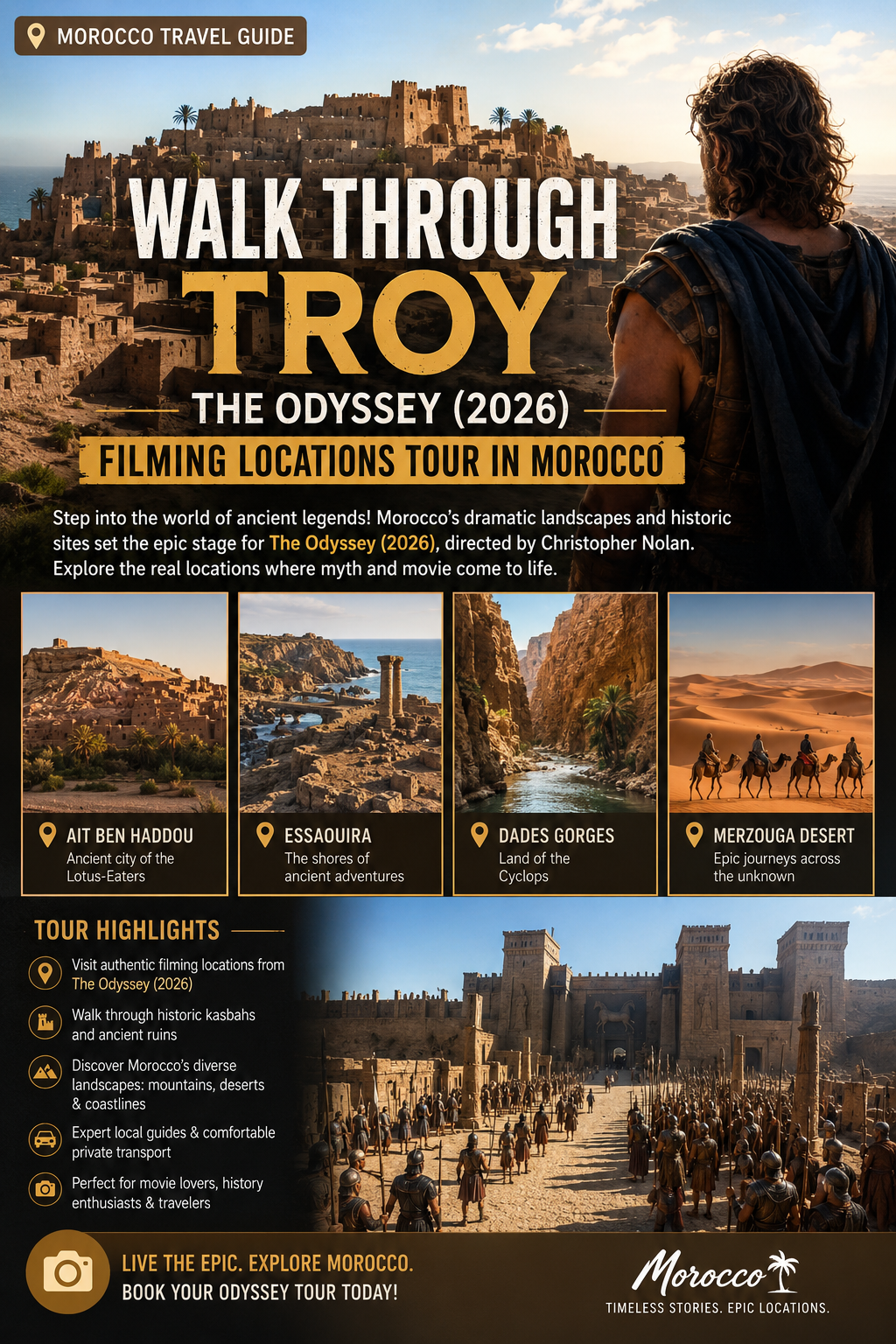
When Christopher Nolan chose Morocco to build the fallen city of Troy for The Odyssey (2026), he was following a path that filmmakers have walked for decades. Matt Damon’s Odysseus, Anne Hathaway’s Penelope and Tom Holland’s Telemachus moved through landscapes that our tour brings you into directly. This journey follows the confirmed, publicly visitable Moroccan locations behind the film, letting you stand where the cameras stood without any promise of access to temporary or private sets.
Aït Ben Haddou: Nolan’s Troy
The heart of the tour is the ksar of Aït Ben Haddou, the 900-year-old fortified earthen village near Ouarzazate that became the backdrop for Troy. The production raised roughly 2.5 acres of temporary, burnable sets beside the ksar, including a pillared temple and city gates, so the real skyline of clay towers could supply the scale and colour behind the burning city. Those film structures were temporary, so what you see today is the authentic landscape itself, not a preserved set.
Aït Ben Haddou stands on the old caravan route between the Sahara and Marrakech in the foothills of the High Atlas, and was named a UNESCO World Heritage Site in 1987. It has also appeared in Lawrence of Arabia, Gladiator and Game of Thrones. You will have time to cross the Ounila riverbed on foot, wander the narrow passages and climb to the granary at the top for a panoramic view. We visit in early morning or late afternoon light, when the earthen walls glow and the crowds thin.
Ouarzazate and the Atlas Crossing
From Aït Ben Haddou we continue to Ouarzazate, long known as the gateway to Morocco’s film industry, with its studios and traditional kasbahs. The route between Marrakech and Ouarzazate runs over the dramatic Tizi n’Tichka pass at 2,260 metres, a spectacular High Atlas drive with sweeping viewpoints and roadside villages. This stretch is roughly 180 km each way and forms one of the most memorable legs of the trip.
Essaouira: The Atlantic Coast
Nolan also brought the production to the Atlantic. Scenes were shot around Essaouira, the fortified port city whose ramparts, beaches and sea walls have drawn filmmakers repeatedly. As an extension to the core route, Essaouira offers a complete change of atmosphere from the desert-facing ksar: windswept sand, gulls, seafood and Portuguese-era fortifications. Four unhurried days let you link Marrakech to the coast without rushing.
Marrakech and the Wider Region
Additional filming took place in and around Marrakech, including the areas of Tahannaout and El Haouz. Marrakech works naturally as the start and end point of the tour, giving you the medina, the gardens and the souks alongside the film-location legs. From here the overland route to Aït Ben Haddou and Ouarzazate is the most coherent way to see the mainland locations in sequence.
A Note on Dakhla
Some coverage of the film mentions filming near Dakhla in the far south, where the Atlantic meets the Sahara. This lies in Western Sahara, a territory the United Nations classifies as non-self-governing and whose status is disputed; the choice to film there drew criticism from Sahrawi rights groups. Reaching Dakhla requires a separate flight and does not fit the same road trip, so we keep this tour focused on the well-established central and coastal locations rather than folding it in.
Suggested Itinerary
- Day 1: Arrive Marrakech, evening medina walk
- Day 2: Marrakech to Ouarzazate over the Tizi n’Tichka pass (2,260 m), visit the film studios
- Day 3: Full day at Aït Ben Haddou, the film’s Troy, with time to climb the granary
- Day 4: Return toward Marrakech, or extend to Essaouira
- Days 5–6 (optional extension): Essaouira on the Atlantic coast
Practical Details
Transport is in our comfortable fleet — Toyota Prado Land Cruiser TX, Ford Tourneo Custom, or Mercedes-Benz Sprinter and Vito for larger groups. A deposit secures your booking via PayPal, Wise or bank transfer, with the balance payable in cash (EUR, USD or dirhams) on day one. We verify what is publicly visitable and never promise access to active or temporary film sets.
The Odyssey opened in cinemas on 17 July 2026. Whether you come for Homer, for Nolan, or simply for the extraordinary Moroccan landscapes that stood in for the ancient world, this tour puts you inside the frame.
